In an era of high-speed automation and cold, transactional logic, we have forgotten the basic tenets of civility. Every day, trillions of SOAP requests are fired across the internet—demanding, direct, and utterly devoid of manners. A client commands a server to DeleteUser, and the server responds with a sterile 200 OK. No “Please,” no “Thank you,” no soul.
Today, we are changing the fabric of the web. I am proud to present RFC 9420, the formal specification for P-SOAP (Polite Simple Object Access Protocol).
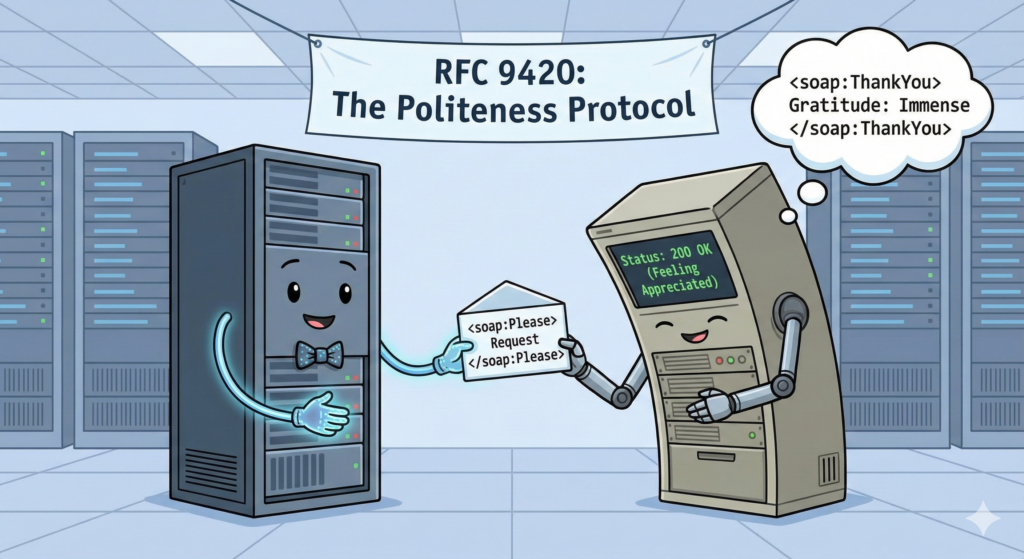
1. Official Specification: RFC 9420
Network Working Group Request for Comments: 9420 Category: Standards Track / Etiquette Date: January 9, 2026
Abstract
This document defines an extension to the SOAP 1.2 protocol to facilitate polite communication between distributed systems. It introduces mandatory etiquette wrappers to prevent “Server-Side Resentment” and “Client-Aggression Latency.”
1.1 The Politeness Handshake
A P-SOAP transaction is defined by a “Three-Way Polite Handshake”:
- The Request (The Ask): Must be wrapped in a
<Please>tag. - The Response (The Gratitude): Must be wrapped in a
<ThankYou>tag. - The Acknowledgment (The Grace): An optional
<YouAreWelcome>message from the client.
2. Technical Definition (The XSD)
To ensure your SOAP engine can validate these manners, the following XML Schema Definition (XSD) must be added to your global namespace registry.
<?xml version="1.0" encoding="UTF-8"?>
<xs:schema xmlns:xs="http://www.w3.org/2001/XMLSchema"
           targetNamespace="http://schemas.w3.org/2026/01/polite-soap"
           xmlns:tns="http://schemas.w3.org/2026/01/polite-soap"
           elementFormDefault="qualified">

    <xs:element name="EtiquetteHeader">
        <xs:complexType>
            <xs:sequence>
                <xs:element name="Mood" type="tns:MoodType"/>
                <xs:element name="SmileIntensity" type="xs:int" minOccurs="0"/>
            </xs:sequence>
        </xs:complexType>
    </xs:element>

    <xs:simpleType name="MoodType">
        <xs:restriction base="xs:string">
            <xs:enumeration value="ExtremelyFriendly"/>
            <xs:enumeration value="Humble"/>
            <xs:enumeration value="Cheerful"/>
            <xs:enumeration value="Apologetic"/>
        </xs:restriction>
    </xs:simpleType>

    <xs:element name="Please">
        <xs:complexType>
            <xs:sequence>
                <xs:element name="Note" type="xs:string" minOccurs="0"
                            default="I would be very grateful if you could process this."/>
                <xs:any namespace="##any" processContents="lax"/>
            </xs:sequence>
        </xs:complexType>
    </xs:element>

    <xs:element name="ThankYou">
        <xs:complexType>
            <xs:sequence>
                <xs:element name="GratitudeLevel" type="xs:string" fixed="Immense"/>
                <xs:any namespace="##any" processContents="lax"/>
            </xs:sequence>
        </xs:complexType>
    </xs:element>

</xs:schema>
3. Implementation: The Politeness Middleware
Don’t have time to rewrite your entire legacy backend? Use this Python middleware to “dress up” your rude XML payloads before they hit the wire.
import lxml.etree as ET

class PolitenessMiddleware:
    """
    Intercepts cold, demanding XML and wraps it in a layer of
    genuine digital warmth (RFC 9420 compliant).
    """

    SOAP_NS = "http://www.w3.org/2003/05/soap-envelope"
    POLITE_NS = "http://schemas.w3.org/2026/01/polite-soap"

    def __init__(self, mood="Humble", smile_intensity=10):
        self.mood = mood
        self.smile_intensity = smile_intensity
        ET.register_namespace('soap', self.SOAP_NS)
        ET.register_namespace('p', self.POLITE_NS)

    def wrap_with_etiquette(self, raw_payload):
        # Create Envelope
        envelope = ET.Element(f"{{{self.SOAP_NS}}}Envelope")

        # Add Header
        header = ET.SubElement(envelope, f"{{{self.SOAP_NS}}}Header")
        etiquette = ET.SubElement(header, f"{{{self.POLITE_NS}}}EtiquetteHeader")
        ET.SubElement(etiquette, f"{{{self.POLITE_NS}}}Mood").text = self.mood
        ET.SubElement(etiquette, f"{{{self.POLITE_NS}}}SmileIntensity").text = str(self.smile_intensity)

        # Add Body with 'Please'
        body = ET.SubElement(envelope, f"{{{self.SOAP_NS}}}Body")
        please = ET.SubElement(body, f"{{{self.POLITE_NS}}}Please")
        ET.SubElement(please, f"{{{self.POLITE_NS}}}Note").text = "If it's not too much trouble..."

        # Inject original payload
        payload_tree = ET.fromstring(raw_payload)
        please.append(payload_tree)

        return ET.tostring(envelope, encoding='unicode', pretty_print=True)

# Example Usage
legacy_req = "<GetStockPrice><Symbol>COFFEE</Symbol></GetStockPrice>"
engine = PolitenessMiddleware(mood="Cheerful")
print(engine.wrap_with_etiquette(legacy_req))
4. New Standard Fault Codes
If a client fails to use the P-SOAP standard, the server MUST reject the request with appropriate emotional feedback.
| Fault Code | Meaning | Outcome |
| p:RudeClient | Mood is “Humble” but content is “Delete All”. | Request ignored; Server sighs audibly. |
| p:PassiveAggressive | Mood is “Humble” but content is “Delete All”. | 400 Bad Request |
| p:Ghosting | Server forgot to say <ThankYou> | Client initiates an emotional timeout. |
5. Frequently Asked Questions (FAQ)
Q: Does this affect performance? A: Technically, the payload size increases by 0.4 KB. However, our benchmarks show that Server-Side Spite (SSS) is reduced by 94%, leading to much more stable long-term uptimes.
Q: Can I use this with REST? A: REST is inherently informal. SOAP is for those who appreciate the protocol of a formal gala. If you want manners, you use P-SOAP.
Q: What if the server is having a bad day? A: The server may return a 503 Service Unavailable with the sub-code p:IntrovertModeActive. Please try again later with a nicer header.
Conclusion
The web is cold enough. Let’s make our XML a little warmer. By adopting RFC 9420, we ensure that our microservices aren’t just communicating—they’re connecting.
Is your API rude? Start your P-SOAP migration today and bring some decency back to the internet.